Contrast and Vision: How Differences Shape What We See
Imagine a world without contrast—a world where everything blends into a dull, indistinguishable blur. Contrast is the magic that brings clarity and vibrance to our vision, allowing us to discern shapes, colours, and textures. It is the key to how we perceive the world; contrast perception can be enhanced using spectacle lenses, making the ordinary extraordinary.
Let's dive in the world of contrast.

What is Contrast?
Contrast is all around us, but it is something we often struggle to fully understand. It is the gentle dance between light and shadow, the bright colours that bring a painting to life, the striking differences that grab our attention.
According to the Merriam-Webster dictionary, contrast is the "degree of difference between things."¹
It's a basic yet powerful idea in art, design, and photography. Artists use contrast to add emotion, depth, and meaning to their work. They play with colours, textures, and tones to tell stories with light and darkness.²

To make it simple, without contrast, Art would lack the vibrancy and complexity that make it compelling and meaningful.³
Everything you need to know about Contrast types
We mentioned earlier that there are many techniques that can be used to show contrast, here is a list of a few of them:
- Tonal contrast happens when using light and dark to create differences, making objects appear more distinct against the background.
- Colour contrast occurs by using variations in the light spectrum (rainbow) resulting in differences in hue, saturation, or brightness.
- Chromatic contrast is used to enhance the visual separation between objects or elements of differing colours.⁵
- Texture contrast refers to the surface quality of an object, such as smooth, rough, or tactile.
- Scale contrast refers to the size of objects, differences in scale among varying sized objects can be used to create emphasis and hierarchy. For example, large objects may be compared to small objects or dramatic changes in scale may be used to draw attention to specific elements.⁵
- Shape contrast is created by comparing different types of shapes. Shape contrast may use a curved shape with an angular shape or contrast a positive shape (object) with negative shape (space).
- Line contrast is created using lines of varying thickness, length, and direction. Thick, bold lines create emphasis or thin, delicate lines to create subtlety and detail.⁵
There are many other ways to create contrast, just to mention a few; - monochrome,
- warm vs. cool colours
- light vs. shadow...
In photography, all of these elements can be fine-tuned to shape contrast, allowing photographers to create the desired mood or visual impact.
By now you should have a better understanding of how to create contrast, but you might still be wondering why is contrast important in our lives.
The Science of Contrast in Vision
Visual contrast is often associated with colour rendering, such as the enhanced contrast provided by polarised lenses or specialized tints for different activities or environments. However, contrast in vision extends beyond colour alone.
Physiology of Contrast Perception
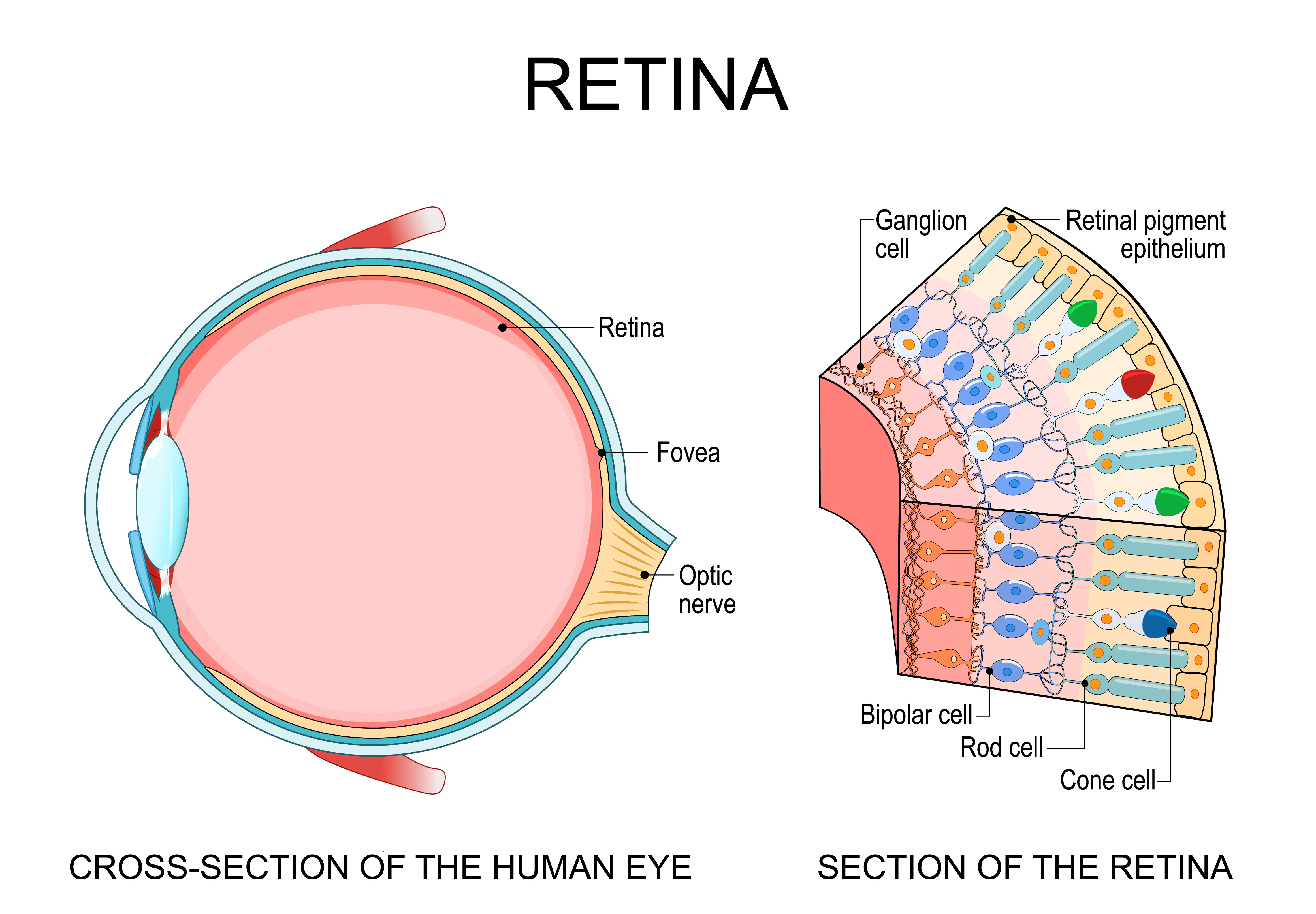
A healthy brain and eyes are essential for accurate contrast perception. The visual system detects variations in light intensity and processes them to enable the perception of shapes, patterns, and depth.
Types of Photoreceptors
There are two main types of photoreceptors: rods and cones.
- Rods: Sensitive to light and primarily responsible for vision in low-light conditions.
- Cones: Responsible for colour vision and function in brightly lit conditions.
Photoreceptors convert light into electrical signals, which are then transmitted to the brain by the optic nerve. ⁷
Distribution and Density of Photoreceptors
The distribution and density of photoreceptors across the retina play a role in perceiving contrast. Areas with a higher concentration of photoreceptors, such as the fovea (the centre of the macula), exhibit greater sensitivity to variations in contrast. ⁸
Role of Ganglion Cells
Retinal ganglion cells receive input from photoreceptors and transmit visual information to the brain. Ganglion cells help the detection of edges and boundaries between different elements, contributing to contrast sensitivity. ⁷
Visual Cortex Processing
The visual cortex, located at the back of the brain, processes and interprets visual information. Neurons within the visual cortex selectively respond to specific features of visual stimuli, such as orientation, direction of movement, and contrast levels. The visual cortex integrates signals from the retina and other visual processing centres to construct a clear picture of the environment, enabling us to perceive contrast and recognise objects, scenes, and patterns. ⁹
Impact of Light Levels
Light levels play a crucial role in our perception of contrast. Variations in illumination could affect the apparent difference in brightness or colour between objects and their backgrounds. Increased light intensity improves contrast perception in healthy eyes but may not improve contrast sensitivity in eyes with conditions like cataracts. ⁸
Contrast in Daily Life
Contrast in vision could affect our daily lives and decision-making processes by shaping our perception of the world around us. It could influence our interactions with the environment, emotions, and preferences, impacting our ability to perform jobs, hobbies, and everyday tasks. In art, contrast conveys emotion and purpose, creating a deep connection between the art and the viewer. ¹⁰
Nikon Lenswear Z Series Progressive lenses are designed to enhance contrast perception through the lens by meticulously refining the geometrical design of specific areas in the lens dedicated to close-up vision. This innovation enhances the quality of the visual experience, elevating your perception of details, clarity, and brightness.
What is Contrast Sensitivity?
Now that you have a clearer understanding of the importance of contrast, let’s talk about contrast sensitivity. Simply put, it is the ability to perceive differences between an object and its background, helping us distinguish outlines, details, and subtle variations in shades and patterns.
Contrast sensitivity contributes to how our visual system detects moving objects, recognises changes in direction, and perceives changes in motion. It supports everyday activities such as catching a ball, identifying obstacles, or following the path of a vehicle when driving.
Contrast sensitivity can be affected by both ocular and systemic conditions. In younger patients, under-corrected or uncorrected refractive error may affect contrast, highlighting the importance of regular eye examinations and appropriate vision correction.
Dry eye ¹¹, a history of LASIK surgery, ¹² genetic and inherited retinal conditions, and amblyopia may impact contrast. ¹³
Cataracts, ¹³ glaucoma, ¹⁴ retrobulbar neuritis, macular degeneration, ¹³ as well as normal age-related changes in the eye ¹⁵ could reduce our contrast sensitivity.
Many neurological and systemic disease like Alzheimer’s, pituitary adenomas, multiple sclerosis, and diabetes mellitus can also impact the ability to see contrast ¹³ which is why it is important to check your contrast sensitivity regularly with your optician.

How is Contrast Sensitivity Measured?
A contrast sensitivity test measures your ability to distinguish between finer and finer increments of light versus dark (contrast). This differs from common visual acuity testing in a comprehensive eye exam, which measures your ability to recognize smaller and smaller letters on a standard eye chart.
Contrast sensitivity is not commonly measured by itself, instead we measure visual acuity to understand one’s eye spatial resolution for high contrast objects.
Visual acuity alone may be insufficient in testing one’s vision and a measurement of contrast sensitivity might serve as an additional diagnostic tool in both healthy eyes and in eyes with disease.⁸
In conclusion, contrast is an integral part of visual perception and impacts our ability to navigate and interpret the world around us. Contrast is the difference between adjacent elements and is used to improve our depth perception, object recognition, and visual acuity. Higher contrast sensitivity provides us with clearer, more comfortable vision, and is vital for daily tasks such as reading, driving, and sports. ¹⁷
Nikon Lenswear Z Series Progressive lenses are designed to enhance contrast perception through the lens by meticulously refining the geometrical design of specific areas in the lens dedicated to close-up vision. This innovation enhances the quality of the visual experience, elevating your perception of details, clarity, and brightness.

1. Contrast. Merriam-Webster. Retrieved March 30, 2024, from https://www.merriam-webster.com/dictionary/contrast.
2. Kaur K, Gurnani B. Contrast Sensitivity. [Updated 2023 Jun 11]. In: StatPearls [Internet]. Treasure Island (FL): StatPearls Publishing; 2024 Jan-. Available from: https://www.ncbi.nlm.nih.gov/books/NBK580542/
3. Tran, Ellie. The Power of Contrast in Art. Etchrlab.com. Retrieved March 31, 2024, from https://etchrlab.com/blogs/news/the-power-of-contrast-in-art.
4. Jirsa, Pye. The Ultimate Guide to Contrast in Photography. Published on August 10, 2022. Retrieved March 31, 2024, from https://www.adorama.com/alc/the-ultimate-guide-to-contrast-in-photography/.
5. Concepts in Graphic Design. Retrieved March 31, 2024, from https://www.coreldraw.com/en/tips/graphic-design-principles/contrast/
6. The Three Dimensions of Vision Satisfaction. Contact Lens Spectrum. Published April 1, 2018. Retrieved March 31, 2024, from https://clspectrum.com/issues/2018/april/the-three-dimensions-of-vision-satisfaction/.
7. Huchzermeyer C, Fars J, Kremers J. Photoreceptor-Specific Loss of Perifoveal Temporal Contrast Sensitivity in Retinitis Pigmentosa. Transl Vis Sci Technol. 2020;9(6):27. Published 2020 May 27. doi:10.1167/tvst.9.6.27
8. Smedowski A, Mikus-Zagorska K, Jakubowska A, et al. Different Impacts of Luminosity on Contrast Vision in Eyes with Transparent Optic Media and with Cataract Simulation. Med Princ Pract. 2015;24(6):501-508. doi:10.1159/000433489
9. Hutton JT, Morris JL, Elias JW, Poston JN. Contrast sensitivity dysfunction in Alzheimer's disease. Neurology. 1993;43(11):2328-2330. doi:10.1212/wnl.43.11.2328
10. Gaskin, Jennifer. A Brief Guide to Contrast – A Design Principle. Published August 18, 2022. Retrieved March 31, 2024, from https://venngage.com/blog/design-principle-contrast/
11. Puell MC, Benítez-del-Castillo JM, Martínez-de-la-Casa J, et al. Contrast sensitivity and disability glare in patients with dry eye. Acta Ophthalmol Scand. 2006;84(4):527-531. doi:10.1111/j.1600-0420.2006.00671.x
12. Hoffman RS, Packer M, Fine IH. Contrast sensitivity and laser in situ keratomileusis. Int Ophthalmol Clin. 2003;43(2):93-100. doi:10.1097/00004397-200343020-00010
13. Hutton JT, Morris JL, Elias JW, Poston JN. Contrast sensitivity dysfunction in Alzheimer'sdisease. Neurology. 1993;43(11):2328-2330. doi:10.1212/wnl.43.11.2328
14. Ichhpujani P, Thakur S, Spaeth GL. Contrast Sensitivity and Glaucoma. J Glaucoma. 2020;29(1):71-75. doi:10.1097/IJG.0000000000001379
15. Yang FF, Hou F, Lu ZL, Hu X, Huang CB. Efficient Characterization and Classification of Contrast Sensitivity Functions in Aging [published correction appears in Sci Rep. 2019 Apr 12;9(1):6240]. Sci Rep. 2017;7(1):5045. Published 2017 Jul 11. doi:10.1038/s41598-017-05294-0
16. Shah K, Naidoo K, Chagunda M, Loughman J. Evaluations of refraction competencies of ophthalmic technicians in Mozambique. J Optom. 2016 Jul-Sep;9(3):148-57.
17. Zimmerman AB, Lust KL, Bullimore MA. Visual acuity and contrast sensitivity testing for sports vision. Eye Contact Lens. 2011;37(3):153-159. doi:10.1097/ICL.0b013e31820d12f4